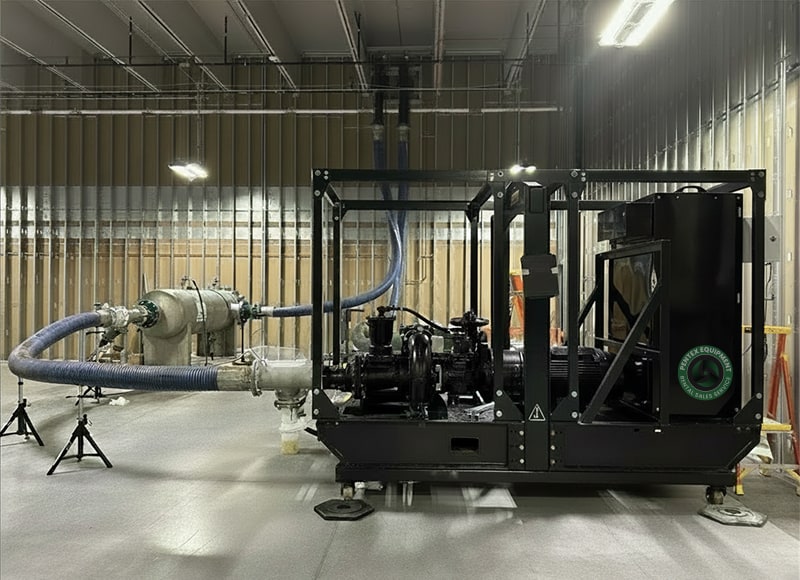
Why Mechanical Flushing Systems Fail
The most common mistake is treating HVAC flushing like a low-pressure rinse instead of a controlled hydraulic process.
Failures typically occur due to:
- Inability to reach the critical velocity required to mobilize fine particulates and scale
- Underestimating Total Dynamic Head (TDH) across long piping runs and vertical risers
- Ignoring system complexity, including multiple branches and return loops
- Using pumps that cannot maintain consistent flow under load
- Lack of filtration, allowing debris to recirculate
In closed-loop HVAC systems, flushing must remove contaminants completely. If not, the system continues to degrade even after the flush is complete.
Technical Considerations
Mechanical flushing for data center HVAC systems requires precise hydraulic control.
In closed-loop HVAC systems, flushing must remove contaminants completely. If not, the system continues to degrade even after the flush is complete.
Key variables include:
- Target velocity of 5 to 8 ft/sec to fully entrain and transport fine debris
- Pipe diameter and total loop length, including supply and return lines
- Friction loss through valves, fittings, and heat exchangers
- Elevation changes in multi-story data center environments
- Contaminant type, including mill scale, weld slag, and construction debris
The system must maintain velocity across all branches of the loop. Any drop below critical velocity allows particulates to settle and remain in the system.
Equipment + Application
Mechanical flushing in HVAC systems requires pumps that can deliver both sustained flow and controlled pressure, while supporting continuous operation.
High Flow Pumps (Primary Loop Flushing)
Used to achieve required velocities in large-diameter chilled water systems.
- Typical sizes: 12 inch, 14 inch units
- Flow capacity: up to 10,000 to 15,000+ GPM
- Application: bulk circulation and initial debris mobilization
Our experts will assess your site, identify the right approach, and help you avoid the common issues that slow projects down.
Medium Head Pumps (Balanced System Flushing)
Used for consistent flow through standard HVAC loop configurations.
- Examples: Super 6 inch, 10 by 8, Super 12 inch
- Flow range: 1,500 to 6,000 GPM
- Head range: 100 to 200 feet TDH
- Application: maintaining velocity across long horizontal runs and moderate elevation changes
High Head Pumps (Multi-Level Systems)
Required for vertical distribution systems or complex piping layouts.
- Flow range: 500 to 3,000 GPM
- Head range: 200 to 400+ feet TDH
- Application: overcoming elevation and friction loss in multi-story facilities
Extreme High Head Pumps (Critical Loop Control)
Used where maintaining pressure is essential across restrictive or highly segmented systems.
- Examples: XH 10 x 8, XH 12 x 8
- Head range: 400 to 600+ feet TDH
- Application: ensuring full circulation through all system branches
Filtration Units (Closed-Loop Protection)
Filtration is critical in HVAC flushing. Units are used to capture and remove debris from circulation to prevent re-entry into the system.
Get a Flushing System That Works
Mechanical flushing in data centers is not optional. It is required to maintain thermal performance and protect critical infrastructure.
At PenTex, flushing systems are built around calculated flow rates, verified TDH, and the specific layout of your HVAC system. We ensure that velocity is maintained across the entire loop and that debris is fully removed, not recirculated.
If you want to review available pump configurations and filtration options, you can explore our product catalog to see how systems are built.
If you are preparing for commissioning or need to restore system performance, the best step is to connect with our team. We will assess your HVAC loop and design a flushing system that meets your operational requirements.
Reach out to PenTex to speak with an expert and ensure your cooling system performs the way it was designed to.