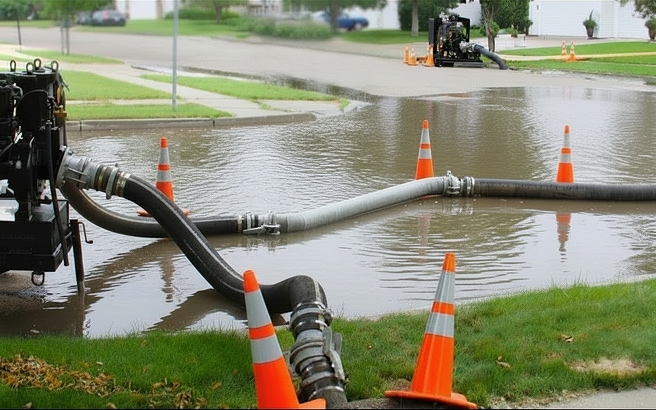
Why Disaster Response Systems Fail
Failures in disaster response are usually tied to poor preparation or incorrect assumptions about system demand.
The most common issues include:
- Underestimating inflow rates during heavy rainfall or system failure
- Selecting pumps based on availability instead of performance requirements
- Inability to handle debris-laden water with solids and contaminants
- Lack of redundancy in case of equipment failure
- Poor discharge planning, leading to recirculation or backflow
-
Emergency conditions require systems that are both powerful and adaptable. Standard setups often fail because they are not built for dynamic conditions.
Technical Considerations
Disaster response pumping requires fast, accurate assessment of hydraulic demand under changing conditions.
Key variables include:
- Inflow rate, which can change rapidly during storms or breaches
- Discharge distance, including temporary routing around affected areas
- Elevation changes, especially in urban or industrial environments
- Debris load, including sediment, trash, and organic material
- Continuous operation requirements, often 24/7 under load
Systems must be designed to handle peak conditions, not average conditions. Undersizing equipment leads to immediate failure in high-demand environments.
Equipment + Application
Disaster response requires high-capacity, reliable equipment that can be deployed quickly and operate continuously.
High Flow Pumps (Floodwater Removal)
Used to move large volumes of water in the shortest possible time.
- Typical sizes: 12 inch, 14 inch, 18 inch, 24 inch units
- Flow capacity: up to 20,000+ GPM
- Application: flood control, large-scale water removal
Medium Head Pumps (Controlled Discharge)
Used when moderate pressure is required to move water over distance while maintaining flow.
- Examples: Super 6 inch, 10 by 8, Super 12 inch
- Flow range: 1,500 to 6,000 GPM
- Head range: 100 to 200 feet TDH
- Application: sustained pumping with moderate elevation or friction loss
High Head Pumps (Long Distance or Elevated Discharge)
Required when water must be moved through extended piping or uphill.
- Flow range: 500 to 3,000 GPM
- Head range: 200 to 400+ feet TDH
- Application: urban environments, infrastructure bypass, elevated discharge points
Extreme High Head Pumps (Critical Infrastructure Protection)
Used when maintaining pressure is essential to protect key systems or prevent backflow.
- Examples: XH 10 x 8, XH 12 x 8
- Head range: 400 to 600+ feet TDH
- Application: critical facilities, high-resistance discharge systems
Filtration and Debris Handling
In many disaster scenarios, water contains debris that can damage equipment or restrict flow. Filtration units and debris management systems are used to protect pumps and maintain performance.
Get a Response System That Holds Up Under Pressure
Disaster response is not just about moving water. It is about restoring control in a situation that is changing by the hour.
At PenTex, response systems are built for rapid deployment and sustained performance. We focus on matching pump capacity to real inflow conditions, ensuring continuous operation, and maintaining control over discharge.
If you want to explore available equipment, you can review our product catalog to understand how different pump classes perform in high-demand environments.
If you are preparing for potential risk or responding to an active situation, the best step is to connect with our team. We will assess conditions quickly and deploy a system that can handle the load.
Reach out to PenTex to speak with an expert and get a response system in place before the situation escalates further.