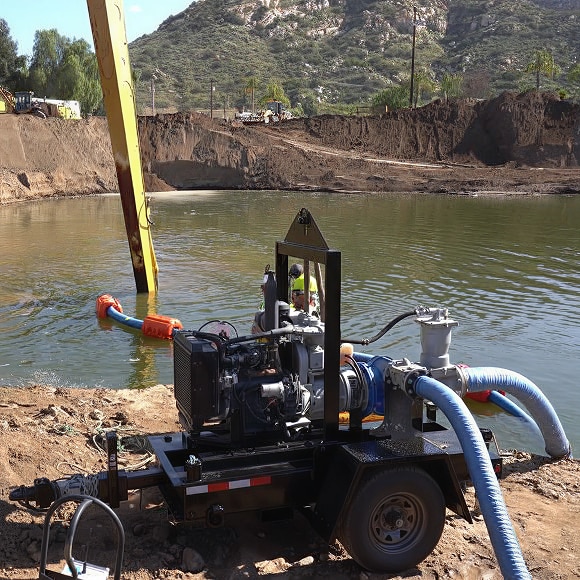
Understanding Transfer Requirements
Water transfer systems must be designed around the full path of movement, not just the starting point.
Key considerations include:
- Flow rate (GPM) required to meet operational timelines
- Distance of transfer, including horizontal and vertical movement
- Total dynamic head (TDH) from friction loss and elevation
- System layout, including bends, fittings, and connection points
- Continuous vs intermittent operation
Without calculating these factors, systems will lose efficiency quickly as distance increases.
Pump Selection for Water Transfer
Water transfer typically prioritizes volume, but system conditions determine the correct pump type.
High Flow Pumps for Volume Movement
Used when large quantities of water must be moved quickly. Common sizes range from 6 inch to 24 inch, depending on required flow rate.
Medium Head Pumps for Balanced Transfer
Super 6 inch and 10 by 8 pumps are used when moderate distance or elevation requires additional pressure without sacrificing flow.
High Head Pumps for Extended Distance
Required when transfer distances are long or when elevation changes impact system performance.
Selecting the right pump depends on maintaining flow without pushing equipment beyond its efficient operating range.
System Efficiency Drives Performance
In water transfer, system design has a direct impact on output.
Critical factors include:
- Proper hose and pipe sizing to reduce friction loss
- Minimizing unnecessary bends and connections
- Matching pump output to system capacity
- Ensuring consistent priming and flow stability
A poorly configured system can reduce output significantly, even when using high-capacity pumps.
Build a Transfer System That
Performs
Water transfer is not just about moving water. It is about doing it efficiently, consistently, and without interruption.
At PenTex, transfer systems are designed around real operating conditions. We focus on maximizing flow, reducing inefficiencies, and ensuring reliable performance across the full distance of the job.
If you want to review available equipment, you can explore our product catalog to see how different pump types are applied.
For projects with longer distances or complex layouts, the best step is to connect with our team. We will evaluate your requirements and design a system that maintains performance from start to finish.
Reach out to PenTex to speak with an expert and ensure your water transfer system is built for efficiency.